
Untitled (work in progress)
When Elon Musk acquired X, the deepfake porn site formally known as Twitter, he described it as the world’s “digital town square where matters vital to the future of humanity are debated”. In response to his takeover, many users migrated to Bluesky and Mastodon, seeking refuge from what they said had become a hostile and unreliable platform. The alternatives presented themselves as a restoration of the internet’s founding promise. As Bluesky’s creators put it, their aim was to build a system for “open and decentralized public conversation”, echoing the original Techno-utopian rhetoric.
In the 1990s, Techno-utopians argued that the internet would replace traditional media altogether. Freed from the gatekeeping of newspapers and broadcasters, individuals would communicate directly, and truth would emerge organically from an interaction of independent voices. Marginalised viewpoints would be heard, and the mainstream media's hypocritical moralising would finally be overcome. They pointed to computer models such as The Boids, which showed how complex behaviour could emerge spontaneously from systems of simple rules. These simulations appeared to demonstrate that order, truth and cooperation did not require central authority, but could emerge organically in well-designed networks.
But Techno-utopianism has failed. The systems they built have given rise to misinformation, political polarisation, and widespread distrust. Rather than producing consensus, social media has divided the public into warring factions.
In response, many now look back nostalgically at an imagined golden age of journalism. But earlier media revolutions inspired similar fears. From the 1970s onwards, television was widely blamed for degrading public discourse. And before that, radio was accused of broadcasting propaganda directly into the minds of citizens.
At the dawn of the radio era, journalist Walter Lippman, concerned with these sorts of problems, ignited one of the most consequential debates about democracy in the twentieth century. He asked whether it was possible for citizens of a large, complex society to make sound collective decisions concerning current affairs, especially given the vast array of knowledge such decisions required. He thought the press - particularly the sensationalist journalism of the likes of Pulitzer and Hearst - had not only failed to faciliate deliberation on matters of crucial public importance, but had made such deliberation impossible. His views are echoed today by those who call for severe restrictions and bans to be placed on social media.
And so he question is: What makes a good system of public deliberation? Has social media just lost its way, and should we go back to the ideas of the original Techno-utopians? Were they right to think that computer simulations could uncover the perfect system for public debate?
This work, currently in progress, seeks to explore this question through the use of game theoretic modelling of the spread of misinformation. I argue that the original conceptions of Techno-utopians were fundamentally flawed, and I hope to show how optimizing for attention by using selection bias can spread misinformation. Furthermore I argue that plausible interventions can only ever minimise the problems, and not eradicate them. Neither should we believe that we can return the internet to the "golden era" of the 90s, nor should we believe that regulation can fix it, even though regulation is sorely needed. Rather a new imaginary is required to address the issues.
Part I
In 1922, Walter Lippmann published Public Opinion, a book that John Dewey, the great pragmatist philosopher, later described it as “the most effective indictment of democracy as currently conceived”. Lippmann’s challenge was not directed at democracy as an abstract ideal, but at the practical possibility of democratic self-government under modern conditions.
His question was simple: how can ordinary citizens in a large, complex society ever have sufficient knowledge of the vast array of subjects required to make sound collective decisions concerning current affairs? His sceptical answer exposed a gap between the ideals of liberal political philosophy and the reality of human behaviour.
Participation in public debate is an integral part of democratic life. This kind of deliberation is an example of what philosophers call practical reason. In contrast to theoretical reason, practical reason is aimed primarily at action, not truth, and is constrained by urgency, risk and uncertainty.
In order to explore similar themes, my previous work, Slime and Reason, considered how a society might respond to a novel and potentially harmful source of food. I simulated a vast decentralised system, the survival of which depended on its ability to share information and deliberate collectively. Could it survive if some of the system's participants gave unreliable testimony? Would panic or poison kill it?
The United States itself faced just such an issue at the turn of the twentieth century as industrialisation revolutionised food production and consumption. How a society deals with consumer panic is just one example of public deliberation in action. As industrial processes revolutionised food production in the late 19th century, new products began to appear on grocery shelves which were greeted with a mixture of awe and fear. When canned food first appeared, the opaqueness of the cans put consumers off. What was really inside them? And how could we know for certain?
It was precisely this loss of direct visibility that concerned Lippmann. To understand its significance, he looked back to an earlier period, before citizens had become so alienated by industrialisation. Pre-industrial America was overwhelmingly agricultural. Many households produced much of their own food, and what they did not produce themselves they obtained locally.
Then, as now, citizens had two primary sources of knowledge: observation and testimony. Farmers identified good food by smell and touch. Choosing a good tomato is a sensory experience - smelling mould, squeezing for ripeness, checking for blight or bruising by eye. When consumers could not rely on their senses but had to rely on others - grocers or butchers for instance - they did so within relatively stable social relationships, where trust was reinforced by social norms and proximity.
As the United States industrialised, its population urbanised, with the result that citizens became alienated from the food production processes that sustained them. The transition from growing your own tomatoes to reaching for a can packed in an unknown place by unknown hands did not come easily. The can not only concealed the quality of it contents, but also its industrial origins. And so a new public debate naturally sprang up: were canned and preserved foods safe?
For most consumers, there was no straightforward way to answer this question. The methods used to preserve and package food were hidden from view, and there was no practical way for individuals to check how products were made. People had little choice but to take others at their word: first the shopkeeper, and beyond them the manufacturer. But these assurances were not always reliable, and often came from those with a clear interest in selling the product. As stories of illness—and sometimes death—began to spread, it became clear that these informal chains of trust were no longer enough. Consumers needed sources of information that were independent, credible, and capable of dealing with the new scale of industrial food production.
Throughout 1919, in rare but highly publicized cases, people fell ill and died after eating canned olives. The first deaths in this epidemic came after a banquet in Canton, Ohio, where five guests and two waiters died. The bacteria Clostridium botulinum produces the deadliest toxin known to mankind, which can’t be detected by sight, smell, or taste. It is anaerobic, meaning it thrives in oxygen-free environments, precisely like created by canning, and doesn't cause any damage to the cans which might help identify it. Botulism soon became the center of widespread media attention. Manufacturers worried that sensational media reports would lead consumers to stop trusting, and therefore to stop buying, canned food.
This public debate about food safety was still raging as Lippman wrote Public Opinion. It was not a purely theoretical debate, even if scientific investigation was crucial. Anyone who considered eating canned food had to decide whether it was safe, yet most lacked the means to investigate the matter directly. The difficulty lay not only in the physical opaqueness of the cans, but in the technical complexity of the issue itself. The science of bacterial contamination was still relatively new—germ theory had only become widely accepted in the late nineteenth century, and its implications for food safety remained an active area of research. The problem is not so much about truth, but about who you can trust.
This is the shift that Lippman's argument highlights. The problem was not that citizens had become less intelligent or less educated. It was that the world they now inhabited had become too vast and too complex to be grasped through direct experience alone. Participatory democracy had become predominantly based on testimony—on information provided by others whose competence, honesty, and motives could not be fully verified.
In my previous work, Slime and Reason I considered the impact of personal behaviour on a wider system. In particular I investigated epistemic vices such as close-mindedness. But individual character is only part of the picture. The integrity of public deliberation depends not just on whether a journalist intends to report honestly, but on how the practices of journalism themselves are carried out. Reporting a death from botulism, for example, involves gathering evidence, interviewing witnesses, and interpreting events for the public. These practices can be conducted in ways that clarify the issue, or in ways that distort it. A journalist need not lie outright to undermine deliberation. By asking inflammatory questions, selecting only the most alarming details, or framing the story to provoke outrage, she can subtly reshape the narrative. It is this corruption of the practice itself—not merely individual dishonesty—that threatens the conditions on which public deliberation depends
This is an example of the distinction between goods internal to, and goods external to a practice. Internal goods define what it is to perform a practice well. External goods, by contrast, evaluate the practice according to criteria that do not necessarily reflect its intrinsic aims. And so the central question is no longer simply whether individuals possess the character traits necessary to be good journalists, but whether the practices themselves are performed in a way that makes epistemic virtue effective.
Sensationalism is only one of many forces that threaten public debate. Commercial pressure, competition for attention, editorial selection, and the influence of powerful interests are all goods external to the practice of deliberation that shape which events are reported and how they are presented.
Lippmann argued that the form of the media made protection of the institutions that sustained public debate impossible. Newspapers mediated every aspect of public discourse - they stood between government, industry, science, and citizens. There was plenty of reason not to trust them. Newspapers depended on advertising, and therefore on industry. They pandered to their readers' many prejudices, and distorted stories to fit. Scientists, meanwhile, were frequently funded by industry, who wanted positive stories for the press to cover. And government was either meddling, incompetent or idle, depending on little more than the journalist's political preferences.
Lippmann’s conclusion in the face of these issues was stark. If public deliberation no longer functioned because of the central mediating role of the press, then the management of public affairs should be entrusted to specialised administrative bodies, such as the FDA. This would disempower citizens and reduce them to a position of dependence, relying on experts to determine what was safe—a condition later critics would describe as infantilising, and characteristic of what came to be called the “nanny state.”

Part II
John Dewey was one of the most influential American philosophers of his generation, and the leading figure in the philosophical movement known as pragmatism. In 1927, he published The Public and Its Problems, a book written in direct response to the challenge Lippmann had posed five years earlier in Public Opinion. Dewey accepted that industrial society had transformed the conditions under which democratic deliberation took place. But he denied that this justified abandoning democratic participation in favour of technocratic administration. Technocracy, in his view, would not solve the problem, but merely displace it, leaving citizens increasingly passive and disengaged.
The investigative journalism example above illustrates the alternative Dewey had in mind. Faced with the same commercial pressures that produced sensationalist journalism, investigative reporters developed professional standards that sought to resist these corrupting influences. Journalists did not abandon reporting because it was vulnerable to distortion. Instead, they attempted to reform it from within, grounding their work in practices of investigation, verification, and public accountability. These efforts were imperfect, but perfection was not the standard. Public deliberation, as an exercise of practical reason, always operates under conditions of uncertainty. The task is not to eliminate these limitations, but to create institutions capable of mitigating them, by balancing the virtues and vices relevant to the practice of deliberation itself.
Dewey believed this principle applied more broadly. The solution to the failures of public deliberation was not to remove the public from the process, but to strengthen the conditions under which deliberation occurred. This required cultivating professional ethics, expanding education, and designing institutions that supported informed and responsible participation. Democratic competence was not a fixed attribute that citizens either possessed or lacked. It was something that could be developed and sustained through the proper organisation of social and political life.
Unfortunately, as the 20th century wore on, the institutions upon which Dewey's solution rested came under increasing attack from neo-liberal and libertarian adversaries, who believed that the tools - algorithms, systems, and technologies - could replace them.
Part III
And so we arrive at the central question this article poses:
(Q) What makes a good system of public deliberation?
Since public deliberation in large societies is conducted primarily through broadcast media—newspapers, radio, television, and now the internet—the question becomes: what qualities does a broadcast medium require to best support the process of public deliberation?
The telegraph began the transformation of public communications, but it was only decades later, as the first radio stations began to broadcast, that Lippmann recognised the profound implications this had had for democracy. Two subsequent media revolutions—first television, then the internet—extended what the telegraph had begun. Each altered not just the speed of communication, but the institutional environment in which public opinion was formed.
When Lippmann published Public Opinion in 1922, many of what we now recognise as the most troubling uses of broadcast media had yet to appear. Over the following decade, new techniques were developed that transformed mass communication into a tool for the deliberate management of public opinion. In the United States, Edward Bernays and others established the field of public relations, applying the new methods of psychology to shape attitudes and behaviour through coordinated media campaigns. These techniques were soon adapted to political ends. Figures such as Father Charles Coughlin, a Catholic priest whose radio broadcasts reached tens of millions of listeners in the 1930s, demonstrated how the medium could be used to cultivate mass political followings, shape public sentiment, and direct popular anger toward chosen targets. In Europe Fascist regimes used radio to disseminate propaganda on a national scale, prompting concern that radio could be used to exert psychological control over the public.
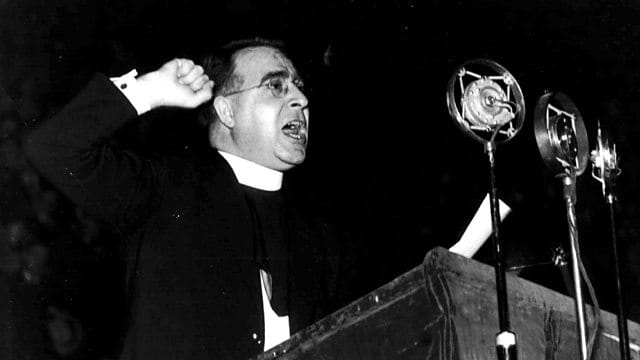



(1) Father Charles Coughlin - known as America's first Radio Priest. A populist preacher who ended his career voicing pro-Nazi opinions that lead to his investigation by the FBI (2) A still from the final scene of Fritz Lang's film The Testament of Dr Mabuse - a curtain is thrown back to reveal a loudspeaker, broadcasting words directly from the mind of Dr Mabuse, who was held in an insane asylum. (3) A still from Frank Capra's Meet John Doe, where a homeless man hired by a journalist to cover up a forgery accidentally becomes a hero (4) A still from Charlie Chaplin's The Great Dictator which bravely ridiculed Hitler's use of the radio.
The outbreak of WWII gave this question critical urgency in the minds of American intellectuals, artists, and policymakers. How could democractic societies confront the fascist menace if mass media tended to turn the psyches of their audiences in authoritarian directions? In response, the US government supported the formation of the Committee for National Morale, which consisted of more than fifty of America’s leading social scientists and journalists, including anthropologists Gregory Bateson and Margaret Mead, and former members of the Bauhaus, such as Herbert Bayer and László Moholy-Nagy.
As Fred Turner describes in The Democratic Surround, their answers to these questions ultimately produced what he called "the ecstatic multimedia utopianism" of the 1960s and, through it, much of the multimedia culture we inhabit today. They argued that mass media failed to reflect the plurality of voices that made America and Americans strong. In order to demonstrate an alternative they put on an exhibition, The Road To Victory, at the Museum of Modern Art in New York. The exhibition presented vistors with an array of visual materials and three dimensional environments within which they could mold their own opinions. Influenced by Dewey's pragmatism, it offered visitors a chance to take part in a deliberative process with a greater degree of agency than radio afforded. In the words of Fred Turner, the exhibition "created an extended field of vision in which American viewers might glimpse utopia. But this time, it would not be the socialist utopia of [the Bauhaus]. On the contrary, it would be the liberal utopia of a world managed from afar by an all-seeing and technologically all-powerful United States." (The Democratic Surround, pages 111-2).
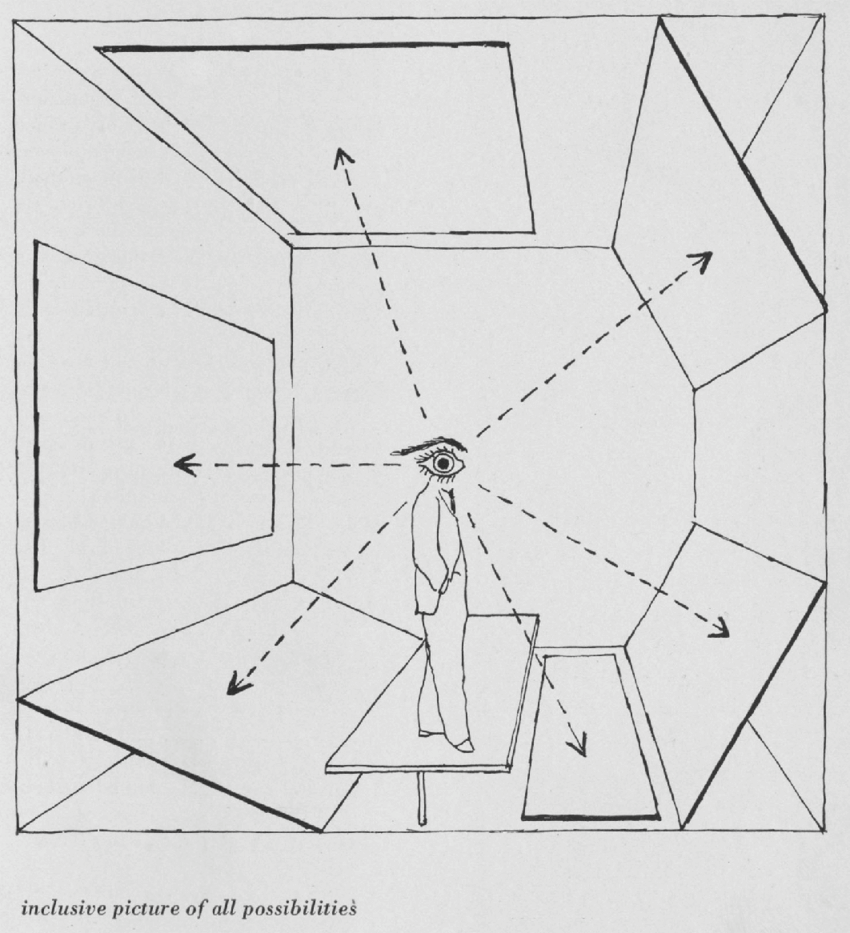

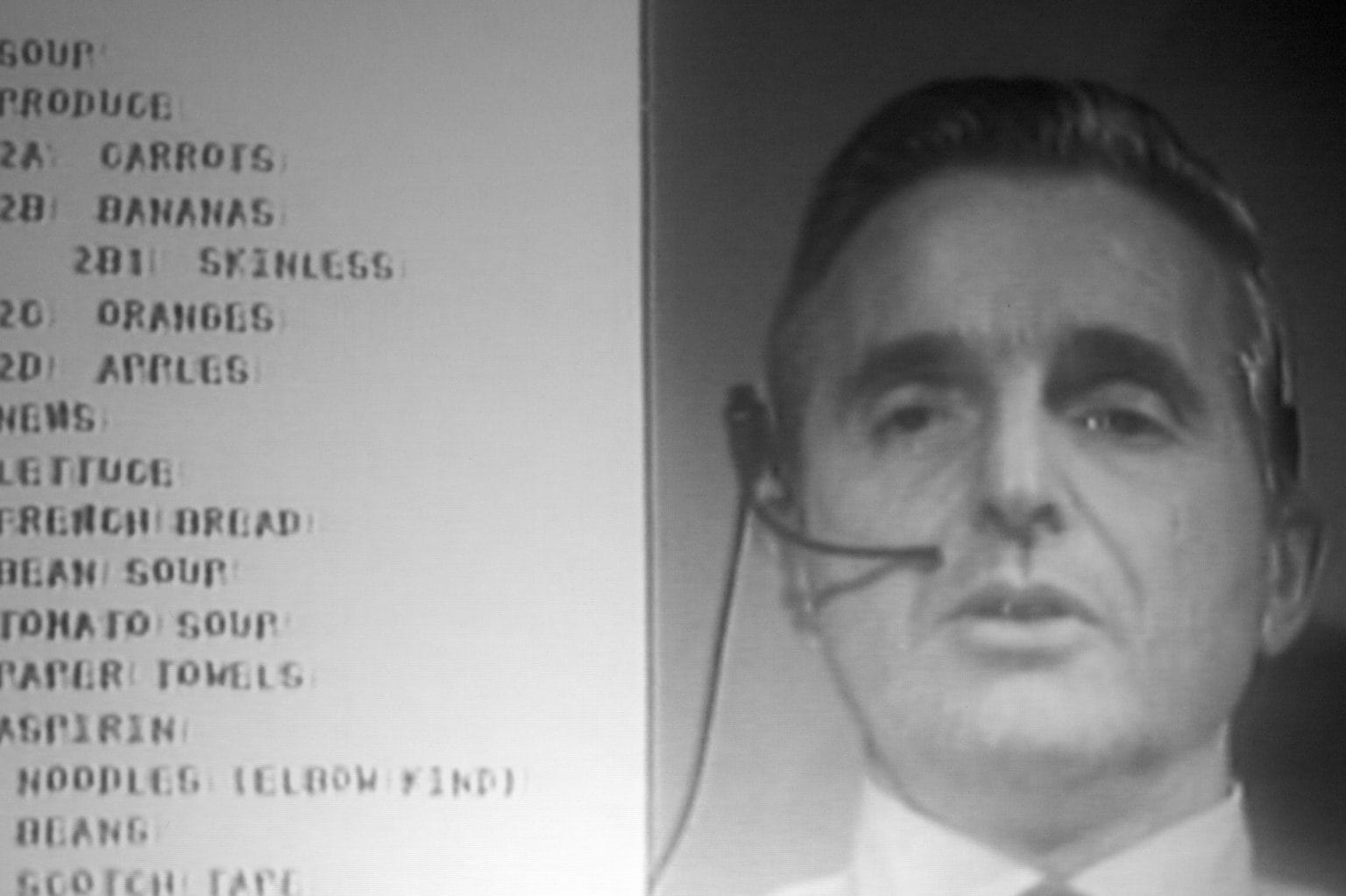

(1) Bayer's sketch of extended vision, 1930s (2) The Road to Victory, 1941 (3) Douglas Englebart demonstrating multimedia computer systems, 1968 (4) A still from Sidney Lumet's Network, in which TV network struggling with poor ratings finds a surprise hit after a newsreader has a breakdown live on air, 1976
If this wartime effort represented the most explicit attempt to apply Dewey’s insights, it also set the US on a path that deviated sharply away from them. In the years after WWII two influential strands of thought—cybernetics and neoliberalism—reframed modern society not as a set of institutions requiring ethical maintenance, but as a complex system of interacting networks. Cybernetics, developed by figures such as Norbert Wiener, treated communication and control as problems of information flow within self-regulating systems. At the same time, neoliberal thinkers increasingly portrayed social order as something that could emerge spontaneously from the interaction of individuals, without the need for deliberate institutional guidance, or indeed behavioural norms. In both cases, the emphasis shifted away from protecting the practices of deliberation, and toward designing systems which allow desirable outcomes to emerge organically.
This shift became especially influential among the Techno-utopian thinkers who came out of the counter-culture. Figures such as Stewart Brand and Kevin Kelly argued that traditional institutions—governments, media organisations, and universities—were inherently rigid and corrupt, and that new technologies could render them obsolete. Personal computers and digital networks, they believed, would allow individuals to communicate directly, bypassing the institutions that had shaped public discourse. As demonstrated at Xerox PARC in the 1960s, computers would be multimedia devices capable of emersing their users in environments within which they could mold their own opinions, but this time, without state or institutional influence.
What is unique about the Techno-utopian position is the argument that computers themselves could design the perfect computerised communication system, by simulation itself. If we can simulate the behaviour of the participants which make up the complex systems of which modern society is composed, they argued, then alternatives can be compared using evolutionary methods. Through rapid cycles of variation, selection, and retention, inferior systems could be discarded and superior ones retained. (Q) becomes an optimisation problem, with progressively better solutions emerging through iterative simulation.
But this approach rests on a conceptual confusion. These simulations evaluated systems according to external criteria—attention, profitability, and so on. Yet the problems of public deliberation cannot be reduced to such criteria, as we have argued. Deliberation is a practice governed by standards internal to it: honesty, good faith, open-mindedness, accuracy etc.
By now the failure of Techno-utopianism is clear. The digital networks that were expected to liberate us are widely seen as contributing to the erosion of democracy. It has become popular to argue that we live in a "post-truth" era, the only escape from which are solutions that echo Lippmann’s pessimistic conclusions. But Dewey's reponse shows a path out of this problem. Whilst western states seem more willing than before to consider censorship and restriction of social media systems, necessary as this may be, it is unlikely to be sufficient to meet Lippman's concerns. Rather we need to consider what new forms of public deliberation the internet might be capable of enabling.
Thus we have two questions in front of us: What do we do about the problems caused by the various existing broadcast systems? And what, if anything, might attempt to solve (Q)?
Part IV
Here are some sketches I have produced using p5.js in the process of investigating this issue. I am still working on the implementation of the game theoretic models, but those models will display a series of nodes, with a belief value between 0 and 1 which maps to a colour scale.


Part V
To date, the simulations I have investigated offer no simple solutions. The mechanisms depicted are features of all broadcast systems to varying degrees. What differs is the network topology. Whilst the Techno-utopians were right that distributed systems are harder to censor, they are more vulnerable to misinformation. They show that misinformation is not merely the result of individual ignorance or malice, but a consequence of systems built without sufficient regard for the nature of institutions which should compose systems used public deliberation.
This leaves us in a difficult position. Strong action against powerful media and technology companies may be necessary to limit the most damaging effects of misinformation, and many countries are now pursuing this path. Yet such interventions cannot restore the idealised conditions of deliberation that Techno-utopian models once promised. The vulnerability that Lippmann identified is not confined to any single medium. It is a structural feature of modern broadcast systems themselves.
One contemporary example points toward a different answer. In Taiwan, the former hacker and now digital minister Audrey Tang has helped develop systems that use computer networks not to bypass public deliberation, but to support and structure it. Platforms such as vTaiwan and Pol.is allow large numbers of citizens to participate in structured discussions, identifying areas of consensus while preserving disagreement. These systems do not attempt to optimise deliberation automatically, nor do they treat public judgement as something that can be engineered from outside. Instead, they are designed to cultivate the practices on which democratic deliberation depends: openness, responsiveness, and mutual intelligibility. In this respect, Tang’s work stands in sharp contrast to Techno-utopianism. It does not seek to replace institutions with tools, but to use tools to strengthen institutions. It reflects a view closer to Dewey’s: that democratic competence is not a given, but must be continually sustained through the careful design of the environments in which citizens think and act together.
Read More
- Fatal Realism, London Review of Books
- Canned: The Rise and Fall of Consumer Confidence in the American Food Industry, by Anne Zeide
- The Democratic Surround, by Fred Turner
- What the dormouse said: how the sixties counterculture shaped the personal computer industry, by John Markoff
- The good hacker: can Taiwanese activist turned politician Audrey Tang detoxify the internet?, by Simon Hattenstone