The revolution will not be tweeted
“Information is the oxygen of the modern age. . . . It seeps through the walls topped with barbed wire. It wafts across the electrified, booby-trapped borders. Breezes of electronic beams blow through the Iron Curtain as if it was lace.” Ronald Reagan, commenting after the fall of the Berlin Wall. (LA Times, 1989-06-13)
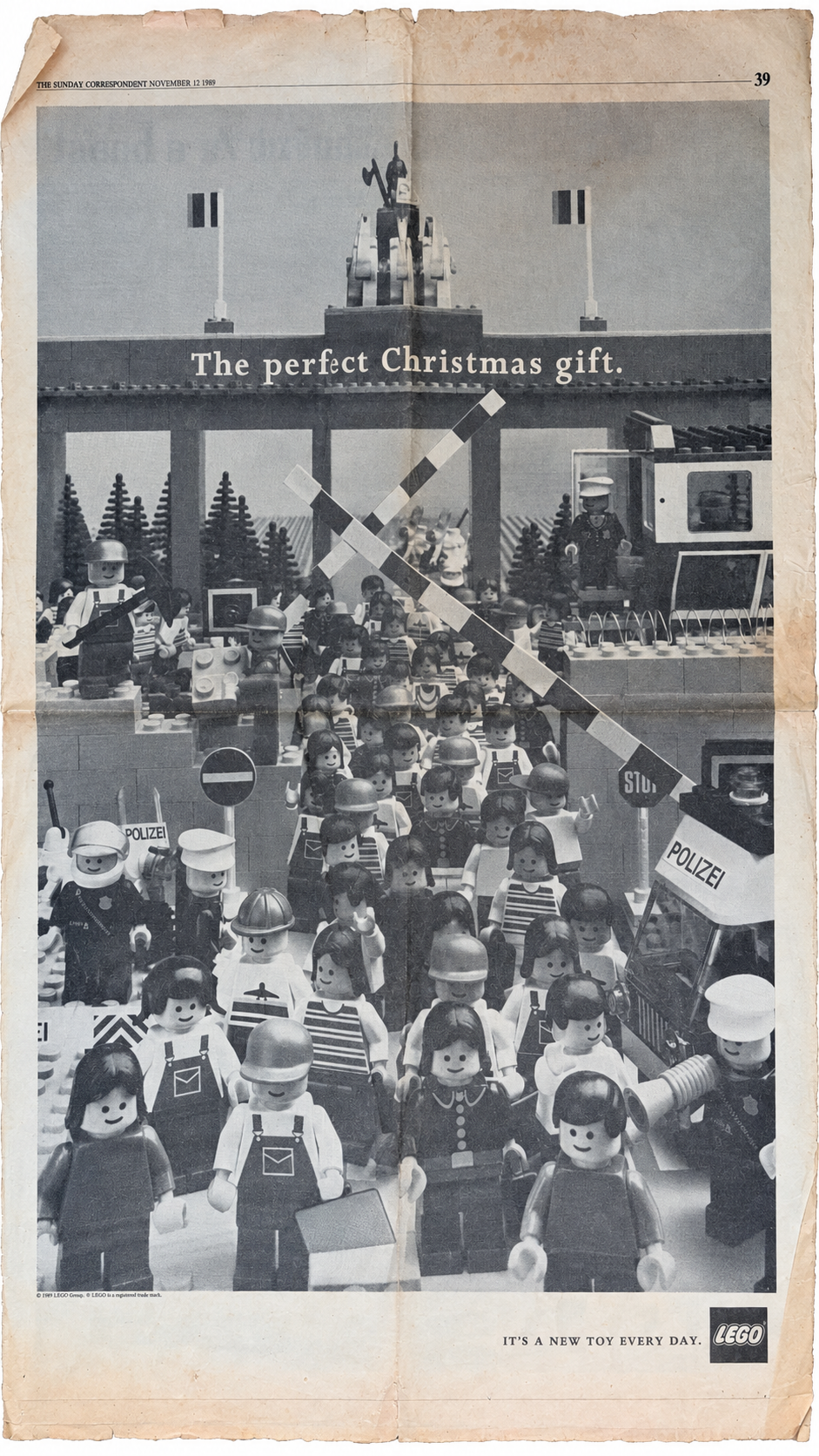
I was eight years old when the Berlin Wall fell. At that time I was obsessed with Lego, and probably the only reason I remember the event so vividly is because the short-live Sunday Correspondent published a photograph of a Lego model showing people streaming through the Brandenburg Gate.
What I was too young to understand was how sudden the collapse had seemed even to the adults involved. Within weeks of celebrating the fortieth anniversary of the republic in August 1989, Erich Honecker had resigned and the Wall was open. Weekly protests held every Monday in Leipzig quickly escalated into what political scientists call an information cascade. This happened despite the memories of 1953, when Soviet tanks had helped crush an East German uprising, and despite the Stasi’s infiltration of the very church groups from which the protests had emerged. Although the regime was failing, censorship and surveillance had obscured the scale of its failure. But Western radio and television signals still crossed the border, carrying images of prosperity and freedom, which only served to highlight the mounting crisis to those in the East. The idea that it was information, not protest nor the regime’s own collapse, that had caused the Wall to fall became a dominant narrative as the West came to terms with what Francis Fukuyama hubristically called “The End of History”. If closed societies could be opened up by information, like TV and radio signals, then the next global political frontier would be the systems through which information moved.
By the early 1990s, politicians were talking about the promises of the new information age and, suddenly, a relatively obscure group of technological pioneers were being celebrated as prophets of the future. Many were connected to the WELL, an early online community founded by Stewart Brand in 1985. They included figures such as Kevin Kelly, the first editor of Wired; John Perry Barlow, former Grateful Dead lyricist and co-founder of the Electronic Frontier Foundation (with Brand); and Howard Rheingold, author of books such as The Virtual Community and Smart Mobs, which attempted to predict how network communication systems would revolutionise the world.
The ideology that emerged from the WELL was later dubbed cyberlibertarianism by philosopher of technology Langdon Winner, which he defined as:
a collection of ideas linking ecstatic enthusiasm for electronically mediated life with radical right-wing libertarian ideas about freedom, society, economics and politics.
Central to cyberlibertarianism was the metaphor of the swarm. Perhaps the fullest expression of this came in Kevin Kelly’s book Out of Control, which argued that decentralised systems could exhibit order, intelligence and adaptability without any central command. Ant colonies, bird flocks, fish shoals, markets, computer networks and human societies could all be understood as systems in which simple local interactions produced complex behaviour. His work made the political appeal of this idea obvious. If intelligence could emerge from the bottom up, then central authority might not be merely oppressive, but obsolete. Could technology render all states obsolete just as it had appeared to do to East Germany?
One cyberlibertarian argument for this obsolescence was that direct communication would make representative institutions unnecessary: if citizens could deliberate, associate and coordinate directly online then the mediation of parties, newspapers, unions, or political representatives would no longer be required. If it seems a little far-fetched that such institutions would surrender power in Western democracies, it is absurd to imagine authoritarian states doing so merely because their citizens had acquired some new gadget, especially when those states often controlled, captured or had replaced those very institutions. However in his book Smart Mobs, Howard Rheingold argued just that. He thought that the emerging communication technologies were so powerful that they could facilitate the overthrow of even the most powerful of authoritarian regimes. He gave the example of the fall of President Joseph Estrada in the Philippines, which he contrasted with the fall of the Berlin Wall twelve years earlier. By 2001 protesters were using mobile phones to organise via SMS. This was decentralised technology in action. Reagan’s “electronic beams” no longer travelled from the state broadcasters of West Germany into closed societies. They moved from hand to hand through the crowd itself. The message was clear: the dictators’ days were numbered.
Rheingold drew on the work of Mark Granovetter, one of the foundational figures of network science, citing an early paper of his which introduced the “threshold model” of collective behaviour. Granovetter argued that people do not decide whether to join a riot, a strike, or a protest in isolation. They look around, and ask: how many others are joining? Some may be willing to move almost alone. Others may wait until hundreds are already in the street. Each person has a threshold: the point at which the visible participation of others makes action seem possible, safe or worthwhile. This means that collective action can suddenly cascade when enough people see others taking part and decide to join them.
According to Rheingold, mobile and networked communications alter the delicate social processes of organisation and mobilisation, by changing the order in which potential participants interact. Instead of news of a protest passing from neighbour to neighbour, images, messages and calls to action could travel rapidly through the ether, prompting people far and wide to join. It was the cyberlibertarian dream in its most seductive form. Liberation would not come from democratic self-determination or resistance to oppression. It would emerge as a new form of coordination between connected individuals.
As a teenager I absorbed these ideas without knowing their names. I encountered them not through political theory, but through music and early internet culture. So by the time I was a young adult not only had I seen protest literally tear down the walls of a totalitarian state and bring freedom to the world, but I believed that this wonderful new technology — the internet — would be my generations’ route to emancipation.
One of the questions I have repeatedly asked since then is why none of this came to pass. At the beginning of the new millenium it seemed as if the cyberlibertarian promise might be fulfilled. They claimed that first the Colour Revolutions, and then the Arab Spring confirmed their theories. But as critics like Evgeny Morozov (in The Net Delusion) and Zeynep Tufekci (in Twitter and Teargas) have argued, none of these protests brought substantive change because networked technologies allowed movements to scale before they had built the organisational capacities that earlier, pre-internet movements had to develop slowly: the leadership, strategy, trust, and institutions necessary for making decisions and resolving disputes. Tunisia, for instance, achieved the most long-lasting democratic transition of all countries which went through the Arab Spring, but has since slid back into authoritarianism. Egypt removed Mubarak, only to see the military return to power under Sisi. Yemen forced Saleh from office, but the transition collapsed into a devastating civil war. The cyberlibertarian promise was that networked technologies would lead to freer, more democratic societies, not simply more periods of destabilisation.
Initially this article takes a somewhat narrower, more technical focus than Morozov and Tufekci. I focus not on movements, but on the process of organisation itself, as understood by network science. Here I am interested in the mechanics of actions as time-bounded, goal-orientated campaigns. That extends to strikes, boycotts, mutinies, political uprisings, and rebellions, but excludes political or protest movements as a whole, even if they are built on those campaigns. Under this narrow definition we can say that tearing the Berlin Wall down was a success in and of itself, despite the fact that many East Germans still feel what Anna Funder calls “an ache for a lost time when things were more secure.” (Stasiland p252). I take this narrow focus because it aligns most clearly with the understanding the cyberlibertarians themsevlves had. I develop a visual simulation based on game theory which depicts the failure of the cyberlibertarian theory.

I argue that the cyberlibertarian promise failed for two related reasons. The first involves the nature of social change. Cyberlibertarians were correct in claiming that unimpeded flows of information would help the formation of protests, but they did not understand the impact the structure of social networks could have for spreading protest. Partly this is because network science had not developed sufficiently in the 90s for this to be fully understood. But cyberlibertarians have failed to update their theories or react to new developments in the field.
The second problem relates closely to the first, and involves a lack of clarity around the concept of decentralisation. I argue that a persistent confusion between polycentric and uncentred networks prevents them from realising the impact particular structures of social networks can have. I argue that since some features of networks can impede the spread of social change, if a network is designed to facilitate protest then it requires some constraints: rules, limits, governance, and so on. But cyberlibertarians balk at such restrictions arguing that the restrictions themselves are a form of authoritarian control. As a result, Silicon Valley built systems that were supposedly free but actually dominated, which has impeded protest in explicit contradiction to their claims.
Whether this was a mistake or a betrayal is another question. It is easier to believe that the pioneers were sincere, if mistaken. But the later generation of tech executives who actually built the systems that had been predicted, i.e. Mark Zuckerberg, Jack Dorsey, Elon Musk, Peter Thiel and others, had slightly different beliefs, even if they borrowed the utopian language of their predecessors. But they are all opposed to the institutions through which collective power is usually built and exercised: political parties, unions, states, newspapers, and so on, and would prefer a world where these were replaced by private companies, if not completely absent. Since their aim was to escape the domination of these institutions, to have built tools which replaced one set of hierarchical structures with another would have looked self-defeating. What they intended political organisation to look like in their imagined utopia was exactly the temporary, leaderless movements that critics like Evgeny Morozov and Zeynep Tufekci have argued lack the capacities of strategy, trust and accountability required to achieve meaningful change.
Why Change Does Not Spread Like a Virus
If I wanted to launch a new brand, gadget or fashion trend, received wisdom says that hiring influencers to promote it would be an excellent strategy. Recruit the right people, give them the product, let them broadcast it to their followers, and hopefully the campaign will “go viral”. This idea long predates social media, but it was popularized in Malcolm Gladwell’s The Tipping Point, one of the defining business books of the early internet age. The Tipping Point was persuasive because it seemed to explain how small actions could produce a momentum that resulted in massive social change. It also put influencers at the heart of this process, some years before social media really took off.
But the problem with this picture, according to sociologist Damon Centola, is that it is a “myth”. In his book Change: How to make big things happen he argues that there are two distinct forms of social change, which he calls “simple” and “complex” contagion. Some things really do spread like viruses: for instance rumours, jokes, news, and fashions can pass from one person to another in a single contact. These are simple contagions. They require just one interaction for change to spread. Complex contagions on the other hand require multiple interactions.
Joining a protest, changing one’s beliefs, behaviour, identity or social norms are all examples of changes that spread through complex contagion. To join a protest, most people require some reassurance. As Mark Granovetter had argued in the 70s, for a person to do this they need to pass a certain threshold, whereby they see a certain proportion of the people around them in their social network behaving differently. What differentiates Centola’s theory from Granovetter’s is that he shows what kind of network topologies facilitate change. And he argues that highly connected nodes, like influencers, can actually impede complex contagions, contra Gladwell.
An example can illustrate why highly connected nodes can facilitate the spread of simple contagions, but impede complex contagion. Suppose I have eight friends and you have twenty four. If I am told a funny joke, I might tell it to all my friends, and they might pass it on. As soon as you hear the joke, and tell it to all of your friends this quickly accelerates the process. This doesn't happen with complex contagion because the mechanism is completely different. Since complex contagions depend on reinforcement from a percentage of one’s neighbours, a very highly connected person becomes difficult to recruit. Consider now what might be needed to make each of us join a protest. Assuming that our threshold for joining a process is passed when we see 25% of our friends are going to join, I will need only 2 friends to join before I join. You would need six friends to join - not impossible but clearly more difficult. Someone with a hundred friends may need twenty-five. Someone with a million followers on social media would need a quarter of a million people to recruit them to the cause. That’s roughly the population of Plymouth. So in practice it can prove very difficult to coordinate the neighbours of a large hub node in order to recruit them. Hubs therefore can act as obstacles to the transmission of complex contagion, even if they are powerful transmitters of information. In a sense this is not surprising. Hubs are powerful, and that power can control those around them, but not vice-versa.
This is a point cyberlibertarianism continues to misunderstand. It treats social change like a virus: a contaminant, a meme, a mind infection, a signal travelling through an exposed population. But complex contagions are complex precisely because people can resist them. Political change does not happen because passive individuals are invaded by alien ideas. It happens when people discover that others around them share their desire for change and are emboldened to act. Even without knowing Centola’s distinction between simple and complex contagions, the idea that social change is a “mind virus” is dehumanising. It sees people as dumb automatons unable to decide for themselves. It also explains an apparent paradox of the internet age: we are better informed than ever before, yet feel increasingly powerless.
The Weakness of Weak Ties
Centola’s work also casts doubt on one of the most celebrated ideas in network theory: the so-called “Strength of Weak Ties”. This idea was developed by Granovetter in his very first academic paper of the same name. That paper has been so influential that it is one of the most-cited scientific papers in the entire field of sociology. In it Granovetter introduced the distinction between “strong” and “weak” ties. For example your close friends and family are your trusted strong ties. They make up your inner social circle. Your casual acquaintances, for instance the people you meet at work or on vacation, are your weak ties.
The strength of strong ties is obvious - these are the people we interact with on a daily basis. The people who will be there in our hour of need. The people we love and care for deeply. Granovetter argued that weak ties are surprisingly powerful. This is because they can shortcut dense parts of a network, carrying information quickly across it. This is how information can spread quickly through word of mouth. Weak ties however are often poor at carrying commitment. Since complex contagions require multiple sources of confirmation or reinforcement, a long, weak tie means an individual can receive a signal from one source, without any reinforcing signals arriving. Thus weak ties can have a discoordinating effect.
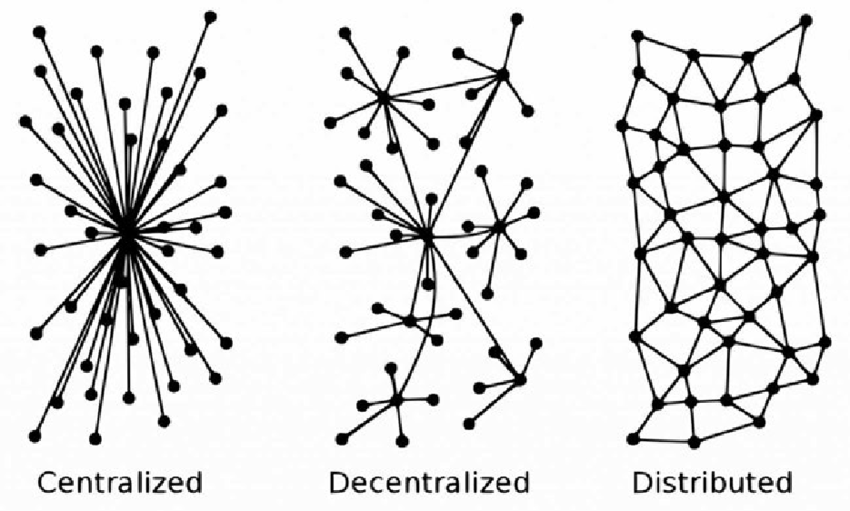
Centola also argues that networks composed mainly of weak ties have a different geometry from networks composed of strong ties. Using Paul Baran’s oft-cited distinction between centralized, decentralized and distributed networks (RAND Corp 1964, above), he suggests that weak ties tend to produce decentralised structures, while strong ties are more likely to produce distributed ones. Real social networks are, of course, mixtures of both: some parts are clustered, intimate and mutually reinforcing; others are loose, distant and broadcast-like. But Centola’s experiments with specially constructed social networks showed that more evenly distributed structures were better at spreading complex forms of social change. (Change pp92-98)
Centola argues that a specific network structure facilitates the spread of complex contagions. Real world social networks are neither totally centralized, totally decentralized or totally evenly distributed. Rather, different parts of the network might be said to be more or less evenly distributed or decentralized. Social media networks are a combination of real world relationships, many of which may be said to be preexisting, for instance family or school friendships, and relationships formed online. This means there may be clusters of people who are closely interlinked. A social change sparked within such a cluster can spread to the whole cluster. But unlike simple contagion, spreading complex contagions between clusters requires more than a few weak links. He describes structures called wide bridges which facilitate the spread between clusters.
Centola’s argument is not that networked technologies have made revolutionary change impossible. They have plainly helped protests form, spread and sometimes succeed. As we have said, if protest is defined narrowly as a time-bounded, goal-orientated campaign, then many networked protests have succeeded. In Tunisia, Egypt, Yemen networked communications successfully helped depose authoritarian leaders. Centola’s argument is that the structure of social networks is the determining factor for the spread of complex contagions, and that structure is not created out of thin air. Demonstrators in these countries used social media systems, sometimes to their advantage and sometimes to their disadvantage. But networked media systems can change the structure of social networks over time, into structures less suited to the spread of complex contagion. This means that networked technologies can actually have a dampening effect on protest.
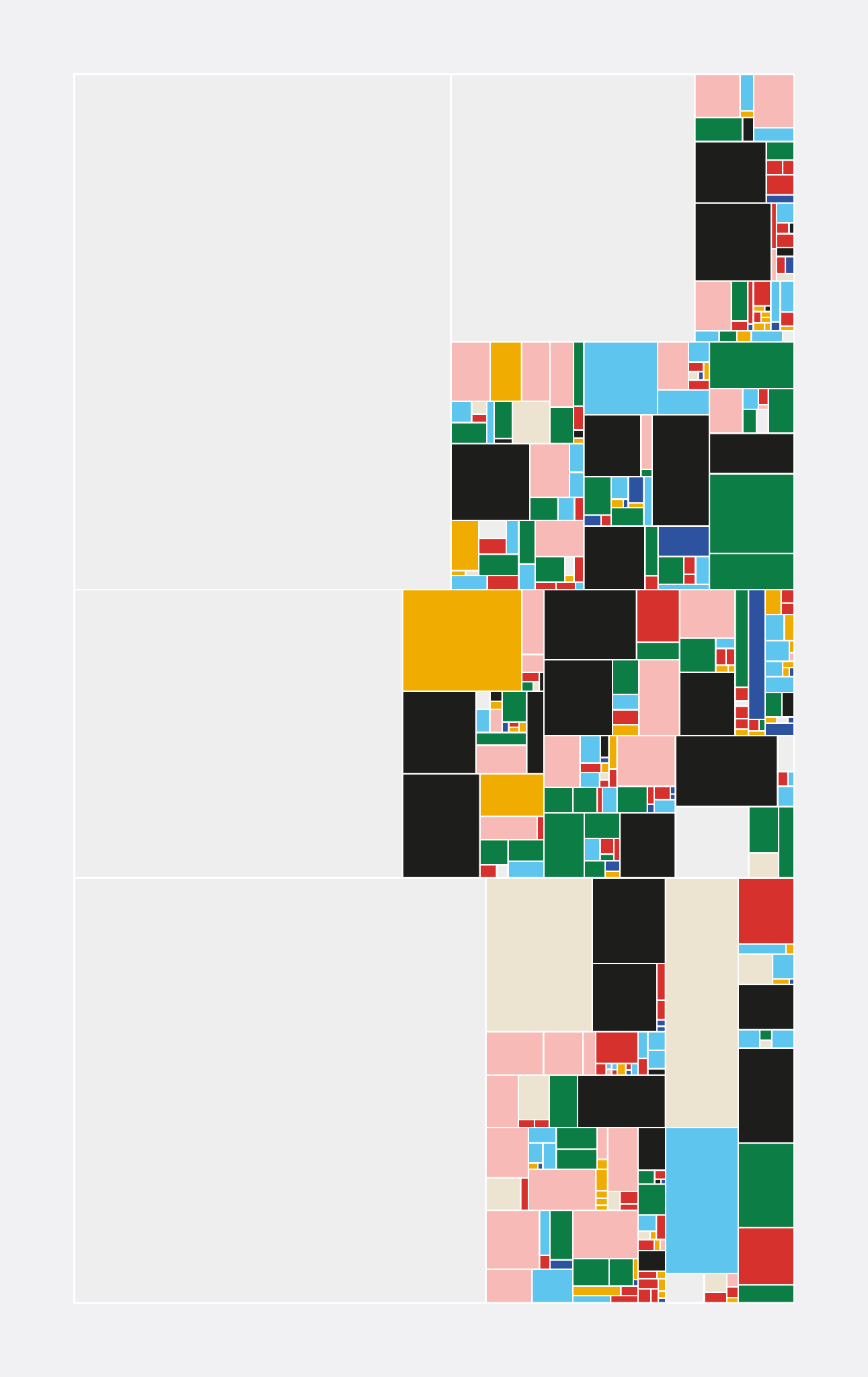
(L) Pre-internet solidary is built slowly through close ties (R) Post-internet, information is spread more widely, in a discoordinated manner.
Decentralisation was never clarified
In 1987 Langdon Winner published an essay called “Decentralization Clarified”, which remains today one of the sharpest analyses of the concept. Decentralisation is a buzz word that is still bandied around, especially in Web 3 spaces, and it is clear that Winner’s entreaties have gone unheard. There he argued that decentralisation is really little more than a metaphor, which depends on how we have abstracted the system under study from the real world.
Cyberlibertarians often treat the concept of decentralisation as if its meaning were obvious. A system with many centres is assumed to be more democratic than a system with only one. But as Winner points out, in some circumstances only one centre is appropriate. For instance, there should only be one body which decides the rules of major league baseball. If we wanted to make the process of changing the rules of baseball more democratic, we wouldn’t open another body and propose a competing set of rules. We’d open the existing body to a more democratic process, such as a popular vote on rule reform.
Cyberlibertarianism persistently ignores such subtleties. Another confusion in this matter is even more fundamental. If a centralised system has one centre, then adding the prefix ‘de-’ must mean the system does not have one centre. But that describes two completely different systems: either a system with no centre or with many centres. A polycentric system could be representative of an oligarchy. An uncentred system, also known as an isocracy (and referred to on Baran’s diagram above as a “distributed” system), could represent the political settlement associated with the Levellers or other anarchists, where power is evenly distributed. Plainly these are two very different systems.
Cyberlibertarians simply try to avoid these complexities. Furthermore, they argue that any attempt to limit, redistribute or govern a decentralised system is self-defeating as it is tantamount to a return of centralised control. But without such constraints, an uncentred system may not remain uncentred. In growing networks, like social media systems, preferential attachment—the tendency for new participants to connect to those already well connected—will likely produce a small number of hubs unless other restrictions are placed on network growth.
That is the contradiction at the heart of cyberlibertarian decentralisation. If a network is allowed to self-organise then some nodes can leverage small advantages into larger ones until significant inequalities have emerged. From the perspective of simple contagion, this looks like success. Hubs can promote faster dissemination of information and the emergence of multiple centres increases its speed and spread. But as we have argued from the perspective of complex contagion, these hubs can become obstacles.
One objection to this is obvious. What would redistribution even mean in the context of a networked communication system? Are we supposed to prevent people following Shakira because she already has too many followers? This sounds absurd. But if one of the political claims made for networked technologies is that they facilitate protest, democratic coordination and collective action, then their structure matters. Design of social media systems is not neutral, but aligned with the profit incentives of the large corporations running them. It promotes one kind of network geometry over another. If Centola is right, then the structure that best spreads jokes, rumours and outrage may be badly suited to spreading solidarity.
Systems can be designed to promote the formation of certain kinds of structure. Consider Whatsapp. It is often used to link together clusters of people, for instance neighbours will often form a street Whatsapp group to chat about matters such as parking, littering, anti-social behaviour and so on. In our increasingly atomised world, where neighbours are less likely to speak to each other, this can be a good thing. This is the formation of a small evenly distributed network. However Whatsapp does not facilitate the building of wide bridges between these groups — the other feature Centola identifies that networks require to spread complex contagion.
This leaves cyberlibertarianism with a dilemma. Either “decentralised” technologies must be deliberately shaped to encourage the kinds of communication that complex political change requires, in which case they need governance, regulation and empirically measured design constraints tied to political, not financial, ends. Or they are left to organise themselves, in which case they reproduce hierarchy and inequality under the guise of freedom. If it is impossible in practice to build networked technologies with the social geometry that Rheingold’s theory requires, then the theory collapses.
Power in unequal societies
As a teenager, when I first encountered cyberlibertarian ideas, I was already aware of the hierarchies of power and wealth that dominate Britain. Britain is a class-based society: stratified by inheritance, education, language and geography. If cyberlibertarianism claimed that networked communication could tear down hierarchy, then it seemed like the right place to test that claim: not in a flat network of equal individuals, but in a society already dominated by wealth and class.
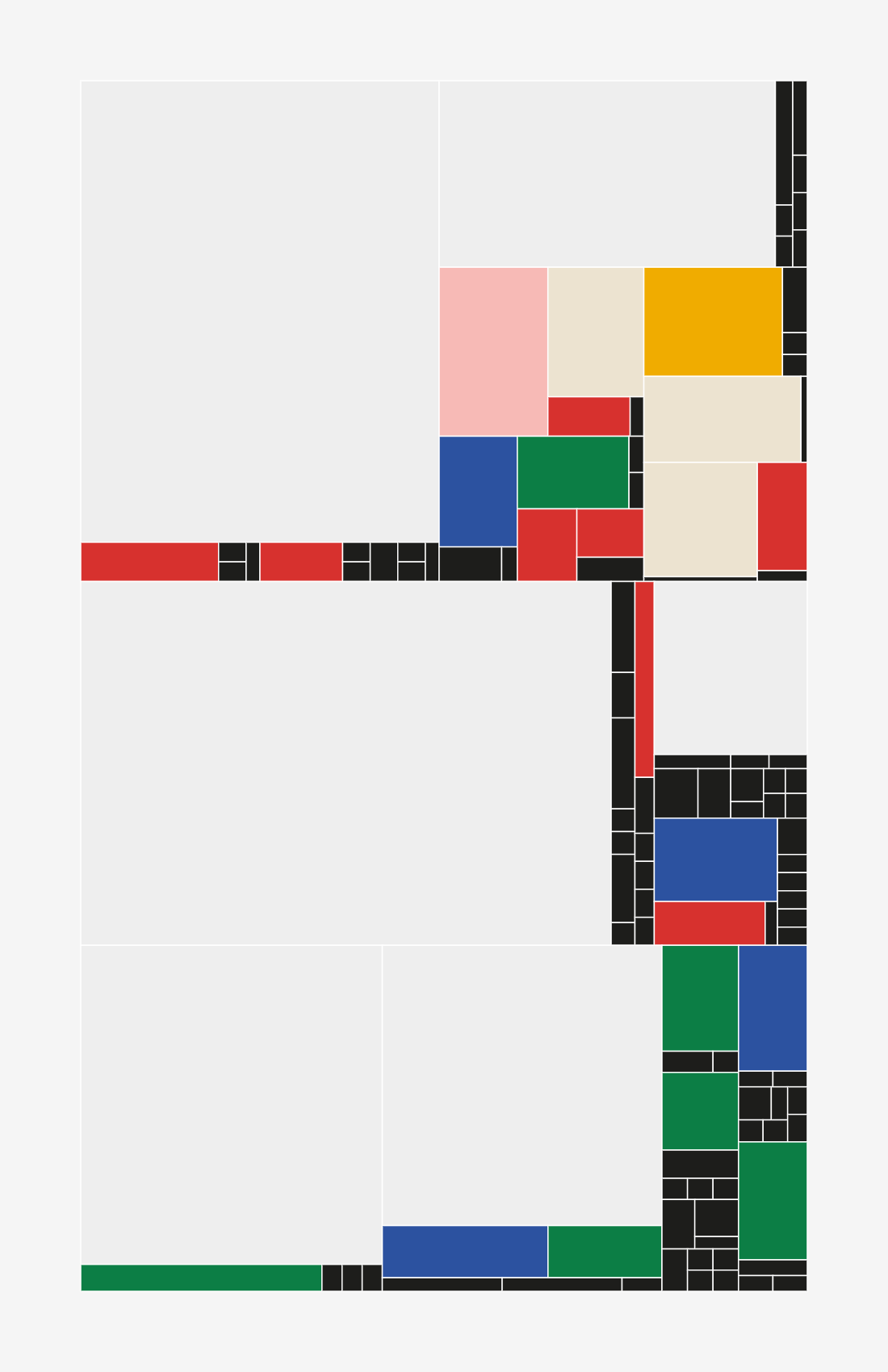
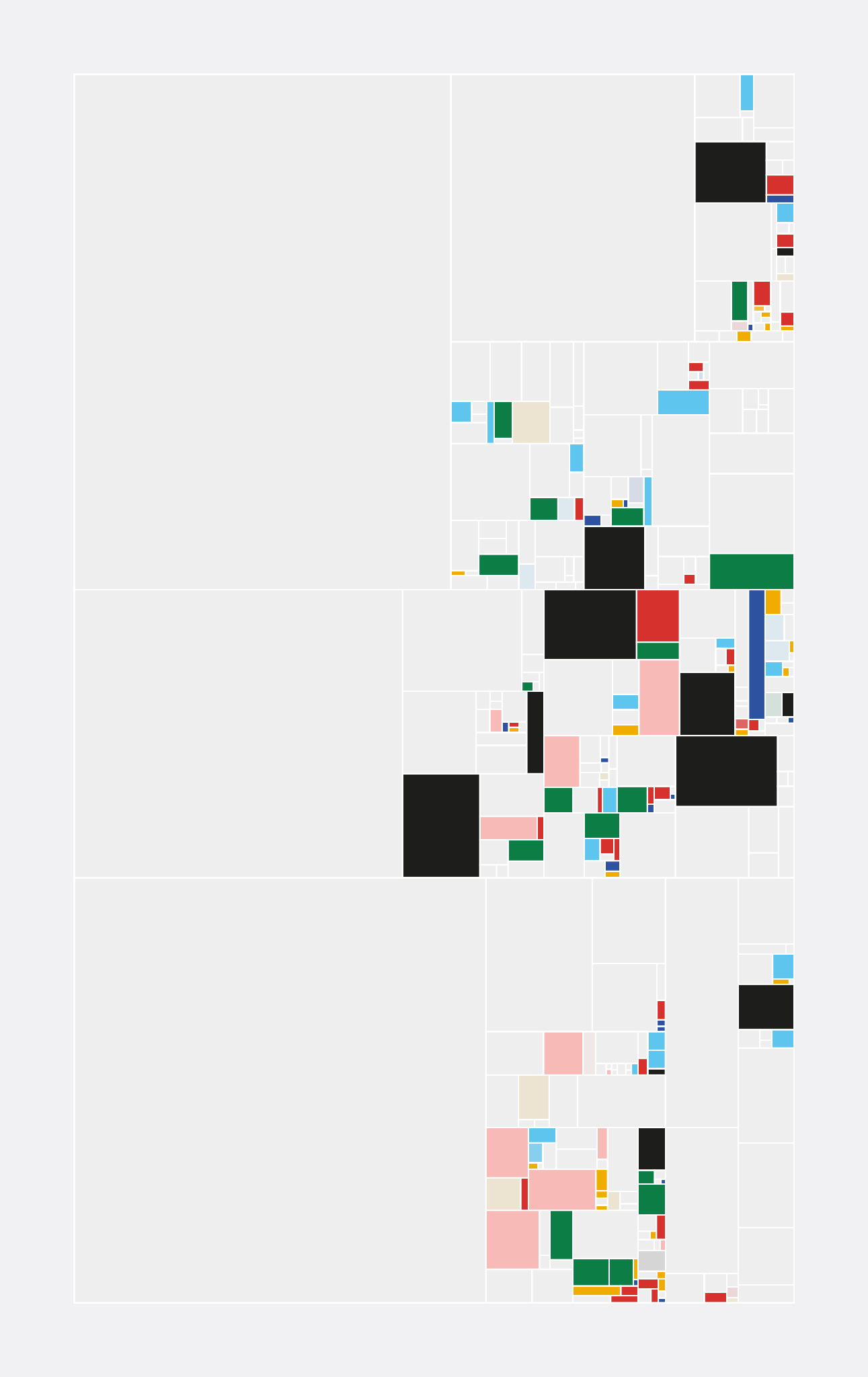
Once I had built a working version of Centola’s model in Javascript, I set about extending it to hierarchical systems. I used what is called a treemap to visualise a hierarchical data structure in a way that would make evident the disproportions of wealth that exist in Britain today. Larger rectangles represent more powerful or wealthy parts of the hierarchy; smaller rectangles are compressed around them. The result is an image that resembles a city: plots of land, buildings, estates, districts, etc.
From this structure, I built a social network. Each rectangle becomes a node. Neighbouring rectangles are connected, forming the kind of local network that might exist in a dense urban space before the arrival of networked communications.
The next step was to simulate the changes that would happen to the social network after networked communication tools were available. This required introducing weak ties. I followed Damon Centola’s method of rewiring some connections at random. In my version, rewiring was also constrained by class. Rectangles were sorted into classes according to their area, which as we’ve said acts as a visible manifestation of their wealth and power. A weak tie could connect distant parts of the image, but only when the two rectangles belong to similar classes.
The simulation then introduced a limited number of triggers to simulate complex contagion. The results were immediately visible. In the default situation, where the network was constructed using proximity and pre-existing hierarchies, contagion spread slowly from one side of the image to the other, almost in procession. When the networks were altered to simulate the presence of networked communication technologies, random connections flickered on and off like fireflies in the dusk. Sometimes cascades did form, but even then they were piecemeal and partial.
The work therefore stages a problem cyberlibertarianism tends to evade. Firms and armies use hierarchical structures explicitly to control communication and prevent mutiny: commands travel from the top downwards, while horizontal association is restricted. Aristocratic and authoritarian societies are looser and more complex than an army, but they nevertheless contain the same tendency. The internet was not built on an empty frontier, but on top of real world social structures. Americans often forget this, because they imagine America itself as an empty frontier. But it was not empty. It was emptied by the genocide of Native Americans, a fact libertarians in particular are keen to ignore. The same cannot be said of the UK. Here, the hierarchy that has ruled for a thousand years is still visible everywhere, and it seems naive to imagine it being torn down by a new technology.
The simulation produces visible results deeming each output a success or failure depending on the size of the cascade triggered. Usually rewired networks do not produce cascades of sufficient size to mobilize the masses against the upper class. Sometimes they do, but rarely. Networks based solely on strong ties usually gain sufficient momentum to topple the aristocracy. These results stand in direct contradiction to the cyberlibertarian’s claims.
Has the right adapted better than the left to the internet era?
So far we have looked at protest narrowly defined, separated from the movements and political parties who use it. Now it is time to turn back to the wider consequences of networked communications on right-wing and left-wing politics. Given cyberlibertarianism’s right-wing roots, it should not surprise us that the systems its proponents built have proved more compatible with right-wing than left-wing politics. Cyberlibertarians are opposed to the institutions through which collective power is usually built and exercised: political parties, unions, states, newspapers, and so on. Since their aim was to escape the domination of these institutions, to have built tools which replaced one set of hierarchical structures with another would have looked self-defeating. They were wrong of course — as we have already argued, without regulation the networks have become dominated by hierarchies of power and wealth anyway. Be that as it may, what remains of political organisation in their imagined utopia was not the party, the union, or the movement, but the temporary, leaderless movements that critics have argued lack the capacities of strategy, trust and accountability required to achieve meaningful change.
We’ve argued that the cyberlibertarians produced systems better suited to the viral spread of information than to the organised spread of action. This does not mean protest has disappeared, nor that networked protests have ceased to achieve aims compatible with left-wing politics. They plainly have. But a communication system that makes distrust, confusion, and resentment easier to produce, while making durable collective organisation harder to sustain, is not politically neutral. It favours forms of action that have become characteristic of the right online: disorientation rather than deliberation, defection rather than solidarity, radicalisation without organisation, and spectacle rather than solution.
The dominant political narrative of the early twenty-first century has not been the democratic renewal cyberlibertarianism promised in the 90s. It has been the rise of right-wing populism, the far-right and conspiracy theory politics, accompanied by a weakening of the institutions that once organised left-wing power; a power already damaged by neoliberalism, deindustrialisation and globalisation. This is not because the right has simply “mastered” the internet while the left has failed. It is because cyberlibertarian assumptions were built into networked systems: suspicion of institutions, hostility to hierarchy, faith in spontaneous self-organisation, and the belief that society is healthier when decomposed into more homogeneous communities.
The first advantage this gives the right is that building coalitions through protest movements is slow, whereas reactionary outrage is faster than ever. Organisers are keen to point out that cyberlibertarian tools offer false hope. They appear to allow organisers to quickly build movements. But time has shown that slow, careful organising works best. That leaves the left at a disadvantage when the latest outrageous thought that has tumbled out of Donald Trump’s brain can circle the globe in under an hour. So much energy is dissipated in reaction and outrage, that this slow careful work is not only unappealing, but appears insufficient. Additionally, if protest movements can spring up quickly, but are less able to harness the feeling they unleash, this is an opportunity for right-wing parties to crack-down on protest on the basis of returning the country to law and order.
The second advantage given to the right is electoral. Left wing politics has historically depended on institutions capable of turning grievances into collective power: unions, parties, voluntary organisations and so on. Right-populist politics has a simpler task, in the sense that it seeks power only through electoral means. It does not need to build a broad collaborative coalition, still less a deliberative public. It needs to identify and convert enough voters disillusioned with the left’s institutions to win a simple majority.
We can see this playout in Brexit and the subsequent fall of the Red Wall. This was not the emergence of a new consensus, let alone a mass conversion from left to right. It was a narrower, more strategic form of defection. Network technologies have not merely divided society, they made those divisions visible in the data collected by social media firms. They allowed parties and campaigns to identify groups whose loyalties had weakened: older Labour voters in post-industrial towns, anti-immigration voters, anti-metropolitan voters, and so on. The aim was to make the previously unthinkable possible: Labour voters switching to the Conservatives. Nor does the right need change to sweep through a country organically. Given enough funding, targeted advertising can reach enough people without relying on those people sharing information through existing networks.
This said, the left is also trying to win elections. New parties have emerged from networked movements, like Podemos in Spain. The point is that in general the slower tactics of organising now seem less powerful than they were a hundred years ago. The 1926 general strike struck fear into the heart of the establishment. Today they have much less to worry about.
The third advantage for the right wing is affective. The right can build coalitions around outrage without having to convert that outrage into constructive collective action. Collaborative politics requires shared beliefs, and therefore some commitment to truth. Right-wing populist politics can gather people around negative concepts: anti-immigration, anti-woke, anti-EU, anti-lockdown, anti-globalist, anti-establishment. These positions need not add up to a coherent programme. They need only produce a shared feeling that something has been taken, concealed, corrupted or betrayed.
This is where conspiracy theories, fake news, disinformation and anti-expert rhetoric become so useful. Their political function is not simply to persuade people of falsehoods. Truth is a constraint on collaborative politics because people who want to build something together must eventually agree on the underlying facts of the situation. But the politics of outrage is true to sentiment not reality. And as we’ve argued, when well targeted it can be enough to swing marginal seats.
A fourth advantage is that some of the far right’s most dangerous forms of action require little coordination. Extreme ideologies are difficult to spread offline. Online, however, isolated people can find others who share the same obsessions, and weak ties can strengthen in the absence of strong counter-balancing offline relationships. As MI5’s director general warned in 2024, “lone individuals, indoctrinated online, continue to make up most [terrorist] threats.” This pattern is far rarer on the left, unsurprisingly for a politics historically based on collective action. In the year to March 2025, Prevent recorded 1,798 referrals related to extreme right-wing concerns, compared with just 21 for left-wing extremism. Even that smaller category deserves caution. In 2025, the government proscribed Palestine Action placing the group — whose proscription UN experts described as a “disturbing misuse” of counter-terrorism law — alongside organisations associated with neo-Nazi and white-supremacist violence, such as the Maniacs Murder Cult and the Russian Imperial Movement. In other words it is possible there simply is no such thing as “Left wing extremism”, at least in the UK. That is no bad thing. But networked media has certainly facilitated a rise in right-wing extremist action, whose threats, myths and grievances increasingly spill into the broader politics of the populist right.
Rheingold has more recently acknowledged this issue, but stopped short of seeing how far it undermines Cyberlibertarianism. Writing in 2020, he said:
“If you believe you are the only gay teen in a small town, or are a caregiver for an Alzheimer’s patient who is homebound, you can connect with others who share your challenges. If you have a rare disease that only one in a million people have, there are two thousand others online, and you can connect with them.
But again, that power does not discriminate, even in ways that might seem appealing. The same power to connect with strangers who may share fringe interests is also useful to Nazis, anti-vaxxers and flat earthers.”
These groups are not isolated for the same reasons. Gay teenagers and people with rare diseases are marginalised by circumstance or prejudice. Nazis are marginalised because most people rightly reject their hateful and violent ideology. By treating them as equivalent beneficiaries of the same communicative freedom, Rheingold remains trapped within a libertarian conception of free-speech. Many European democracies have imposed limits on the freedom of speech that can distinguish between the protection of minorities and the promotion of fascism, racial hatred and violent extremism. Nazi content can be censored, extremist organisations can be banned, and individuals who use social media to recruit for violent movements can be excluded from those platforms. This refusal reflects a persistent cyberlibertarian confusion. Because they identify centralised authority itself with fascism, they treat censorship, regulation or exclusion as the greater danger, even when the real threat is fascism itself exploiting networked media with far more damaging consequences for everyone else. Such powers can, of course, be misapplied, as the proscription of Palestine Action demonstrates. But the answer is not to abandon regulation and leave networked media open to organised fascism and violent extremism. It is to subject those powers to checks and safeguards — including judicial review, parliamentary scrutiny, indeed protest itself — that restrain the authoritarian tendencies of government.
The fifth advantage right-wing politics has concerns the manipulation of the communication systems themselves. This is politics as information war: not the attempt to deliberate, persuade or organise, but to manipulate the informational environment in which politics takes place. Astroturfing, for instance, is the creation of fake grassroots activity designed to create the appearance of widespread public support. In 2019 the Guardian exposed a network of pro-Brexit Facebook which included groups such as Mainstream Network and Britain’s Future. They presented themselves as independent public campaigns, but many shared administrators linked to Lynton Crosby’s CTF Partners. (Lynton Crosby is a former adviser to Boris Johnson, who at that time was trying to oust Theresa May on the basis of the supposed weakness of her Brexit deal). Together the groups spent up to £1m on targeted Facebook ads encouraging voters to pressure MPs into backing a harder Brexit. This deserves restating: even the most senior, mainstream right wing figures are involved in the deliberate manipulation of the networked systems that now form the public sphere.
These tactics of inauthenticity can also move offline. The recent UK flag-raising campaign, “Operation Raise the Colours”, presented itself as a spontaneous outpouring of patriotism, but Hope Not Hate reported that it was organised by a small number of well-known far-right activists, including figures linked to fascist organisations such as Britain First and the English Defence League. This was spectacle more than protest. It did not require a mass movement of people, complex organisation, or even much coordination. A whole road festooned with flags gives the impression that everyone on the street supports it, even if the work was done by a handful of people at night. It produces images of mass mobilisation, but with the masses strangely absent.
Yet another tactic that is used broadly by the right, is to overwhelm the shared public space so that organising, opposing or even understanding politics becomes impossible. Lynton Crosby called this “the dead cat strategy”, but Steve Bannon’s formulation was even more visceral. He called it “flooding the zone with shit”. Trump’s genius is to turn this into a non-stop firehose of excrement: a daily soap-opera of scandal, denial, counter-scandal, insult, memes, and so on.
At the most extreme end of this sits tactics associated with accelerationism. Accelerationists start from the position that society is irredeemable, and that technology, violence or destabilisation can hasten its collapse and create the conditions for a new order. Better-known figures such as Nick Land and Curtis Yarvin have helped popularise anti-democratic fantasies of exit, collapse and post-liberal rule, and Yarvin in particular has been taken seriously by parts of the contemporary American right, including figures around JD Vance and Peter Thiel. But they are the salon version of a much uglier formation. In white-supremacist accelerationism, violence is embraced as a means of catalysing social collapse. This is a warning that bad as Trump’s political behaviour is now, there’s plenty of scope for it to get worse.
What is interesting is that Rheingold actually predicted this danger as far back as 1993. In “Disinformocracy” (Chapter 10 of Virtual Communities), he argued that since a functioning public sphere was essential to the process of deliberative democracy, it was vulnerable to the very kinds of manipulation we’ve been discussing. Writing more recently about the state of networked media, he reminds us that he was among the earliest figures to warn of these dangers. Admittedly, in the 90s, it would have been difficult to imagine the industrial scale of manipulation now possible online. Nevertheless Rheingold concedes that he underestimated this. But he now blames much of the problem on firms like Meta pursuing profit, and he does support some form of regulation. Yet this does not resolve the contradiction at the heart of cyberlibertarianism. The original promise was that networked society would be self-regulating: open communication, decentralised association and access to information would produce more democratic outcomes by themselves. This is a familiar and inadequate defence: the problem was not simply corporate capture, but the libertarian faith in self-regulation that allowed these systems to develop without democratic constraint in the first place. How could someone so alert to the dangers of networked media remain so convinced of its democratic promise? Winner’s definition of cyberlibertarianism helps resolve the paradox: it was an “ecstatic” belief in the liberating power of technology, one that allowed its adherents to recognise visible dangers without fully absorbing what those dangers implied.
Taken together, these forms of politics reveal the dark side of the cyberlibertarian dream. Networked communication did not produce the liberated public sphere its advocates promised. It produced systems readily available for manipulation, radicalisation, and information war. A genuinely emancipatory theory would have treated these outcomes as a crisis. Some cyberlibertarians, amongst them Rheingold, as we have noted, have acknowledged that things haven’t quite worked out as they expected. Few have gone as far as Jaron Lanier, who famously wrote a book suggesting that we should delete our social media accounts. Most cyberlibertarians think the problem is the monopolistic power of corporations like Meta. But cyberlibertarianism has failed to look deeper into its own ideology and ask whether decentralisation, anonymity, self-organisation, free-speech absolutism and hostility to institutions might themselves be part of the problem.
Conclusion
As a teenager I believed the cyberlibertarian narrative. Its failure to deliver has been a constant source of disappointment and confusion in my adult life. My art practice seeks to pick apart this ideology using its own methods and tools in order to understand and critique it. As with my previous work, Slime and Reason, my objective here is not to propose some new theory which might resuscitate the cyberlibertarian dream of the 90s. Rather it is to present a counter-example to the supposed inevitability of their predicted outcomes. They could have made different decisions with consequences that were less awful, even whilst staying within a broad cybernetic framework. Instead cyberlibertarians helped build systems ripe for exploitation by the very authoritarians they claimed they wanted to weaken.
I have argued that the cyberlibertarian promise to liberate the world by building technologies that facilitated protest, narrowly defined as a time-bounded, goal-orientated campaign, failed because of two flaws in their ideology: their misunderstanding of decentralisation, and their misunderstanding of social change. Together, these produced networked communication systems that could circulate information at unprecedented speed, but did not facilitate the process of organisation. In the wider sense, where protest is a tool of movements, we have noted that networked movements are often not capable of achieving durable, meaningful change. This has been obvious to many critics, and has become clearer as time has worn on. Yet cyberlibertarians still cling to their discredited ideology.
Authoritarian regimes and right-wing populist parties have been able to adapt successfully to this new era. Instead of relying on subservience and fear, they now operate by creating chaos: a swirling spectacle of distraction, outrage, conspiracy and grievance which divides potential allies whilst making collective action harder to sustain. In practice, networked technologies have often favoured right-wing political movements over left-wing ones, and have also facilitated the most extreme forms of right-wing action. The result has not been the democratic renewal promised in the 1990s, but the further weakening of a left already damaged by deindustrialisation and neoliberalism. What is needed now is a new vision of networked communication technologies, compatible with democracy and protest, that can truly bring freedom to the world, rather than wealth and power to the few.